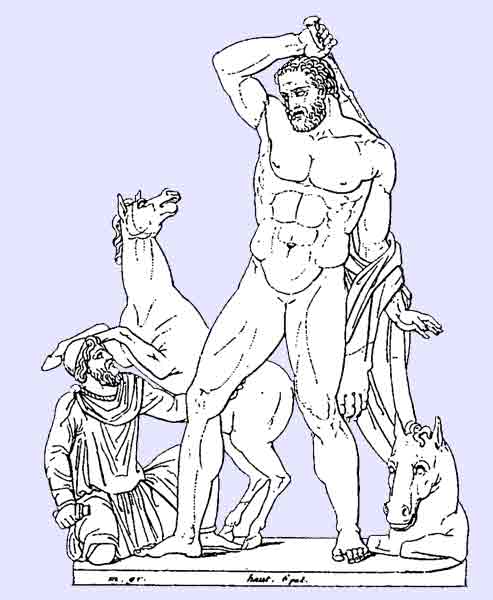
(Continued from Herakles' Seventh Labour) Herakles' Eighth Labour - the Mares of Diomedes The king of the Bistones in Thrace was a man called Diomedes, and he was a particularly nasty fellow. He was supposed to have been the son of Ares and Cyrene, or perhaps the incestuous offspring of the nymph Asterië and her father Atlas. Like Augeus, he had stables, but while Augeus' stables were just filthy, Diomedes' were the terror of Thrace. In these stables Diomedes kept four savage mares, tethered with iron chains to their bronze mangers, and he fed these mares with the flesh of unsuspecting guests and travellers. Eurystheus ordered Herakles to capture these mares as his eighth Labour, so Herakles gathered a number of volunteers to help him, and set sail for Thrace. On arrival, Herakles set up camp on a small hill that occupied the ground between the sea and the low-lying plain which led to Diomedes' fortress, Tirida. Here he made certain preparations, then set off with his companions under cover of night. Diomedes and his warrior cronies were feasting and drinking heavily, so noticed nothing when Herakles and his band burst into the stables, While his friends overpowered the grooms, Herakles seized the chains which tethered the mares and ran, breaking the chains and dragging the bewildered beasts behind him. With his companions, he made it safely back to his base before Diomedes became aware of the raid. When finally one of the grooms broke free of his bonds, and ran into Diomedes' hall with the news, Diomedes and his warriors grabbed their weapons and followed the trail to Herakles' camp. Herakles had expected this, and leaving the mares with one of his companions, a man called Abderus, he led his other companions to repel Diomedes and his unsavoury warriors. Now the preparations he had made before the raid came into their own. Herakles had cut a channel from the sea partway through the hill. When Diomedes' band were almost upon them, Herakles made the final cut to open up the channel - and the sea rushed in to flood the plain in a matter of minutes! Diomedes and his crew ran in terror, and Herakles sped after them, and stunned Diomedes with a blow of his wild-olive club. He dragged the body back around the lake that had formed, back to the hill where he had made his camp. What an unpleasant sight awaited him; while he and his other followers had been repelling Diomedes' warriors, the mares had turned on Abderus, Herakles' friend, and torn and eaten his body. Herakles was heartsick, he had not realised just how strong the mares were, far too much even for brave Abderus unfortunately. In disgust, he threw down the reviving Diomedes in front of the mares, and watched impasively as the mares ravaged Diomedes, tearing his flesh apart while his shrieks gradually became feebler until he was no more. To honour his friend, Herakles built him a fine tomb where he had been killed, and founded a new city beside it, which he called Abdera. He went back to Tirida and sacked it, then took Diomedes chariot and harnessed the mares to it, although they had never known a bridle or bit before. He drove the chariot across the mountains to Mycenae, where Eurystheus dedicated the mares to Hera and set them to roam free on Mount Olympus (after his failure to impress Hera by setting free the Cretan Bull, he now tries yet again by setting free vicious man-eating animals. It is no wonder Eurystheus had a bad reputation). Diomedes' fortress remained in ruins, but in the new city of Abdera athletic games were celebrated every year to honour Abderus - all the usual events were held, except for those involving horses... NEXT: Herakles' Ninth Labour - click here
|
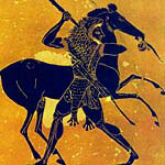 Bearing in mind that all these stories originated in the Bronze Age, it would seem probable that the 'iron chains' that tethered Diomedes' Mares were a late addition to the tale.
The Mares were called Podagros (the fast), Lampon (the shining), Xanthos (the blond) and Deinos (the terrible).
 |
