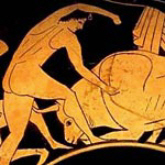
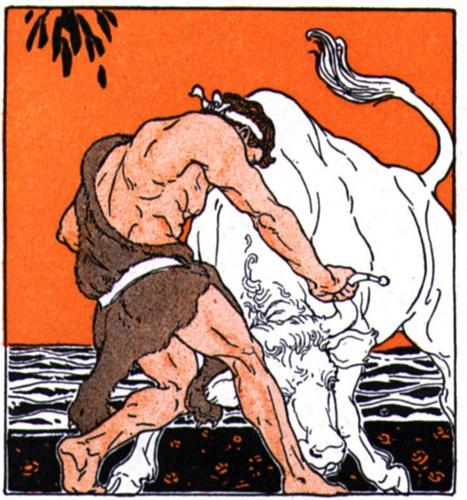
(Continued from Herakles' Sixth Labour) Herakles' Seventh Labour - The Cretan Bull When Minos claimed the throne of Crete, as proof of his right to rule he boasted that the gods would answer whatever prayer he offered them. Then, dedicating an altar to Poseidon, he made preparations for a sacrifice, and prayed that a sacrificial bull would emerge from the sea (bulls and horses were especially sacred to Poseidon - we still refer to the foam on the waves as 'Neptune's Horses'). To the amazement of all, a shining white bull swam ashore, but Minos was so dazzled by its beauty that he sent it to join his herds, and sacrificed another bull instead. Now, of course, this didn't impress Poseidon one little bit, as he took Minos' behaviour as being theft of one bull that he owed to Poseidon, so, being a god, he took revenge as only gods can! Pasiphae was Minos' wife - Poseidon cruelly made her fall in love with the beautiful white bull that had been withheld from sacrifice. Pasiphae was consumed with a bizarre passion for this beast, and in the end confessed her secret desire to Daedalus, the inventor, who was living in Knossos (the capital of Crete) at this time. Daedalus constructed an amazingly lifelike hollow wooden cow, inside which Pasiphae could hide and requite her passion for the bull. She later gave birth to the Minotaur, a monster with a bull's head and a man's body - but that's the story of Theseus, which comes much later. The bull itself eventually ran wild and ravaged Crete, uprooting crops and knocking down walls wherever he chose to go. Eurystheus ordered Herakles to capture the Cretan Bull, so off to Crete Herakles sailed. When he got there, Minos offered him every assistance he could think of, but Herakles liked to work on his own for this sort of work. The stories do not actually relate exactly how he captured the bull, but it was probably by dropping a net on it from a tree while the bull grazed below, but he would still have had a major struggle on his hands just holding on until the bull tired itself into placidity! He finally managed to get it back across the Aegean Sea to Mycenae, where Eurystheus, dedicating it to Hera, set it free (this guy must have been the Ancient Greek version of our own modern politicians - he's just been given a huge fire-breathing bull which has been tearing one country apart, so he sets it free in his own country!). Hera, however, was having none of this - Eurystheus's "gift" only added to the renown of Herakles, whom she loathed, so she drove the bull to Sparta, then back through Arcadia, and finally across the Isthmus to Marathon, creating havoc everywhere it went (the gods had a strange sense of what was fitting!). The bull was eventually (years later) captured by Theseus, who took it back to Athens and sacrificed it to Athene. |
 Neptune is, of course, the Roman name for Poseidon.
 |
