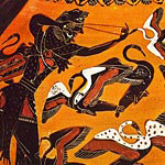
(Continued from Herakles' Fifth Labour) Herakles' Sixth Labour - The Stymphalian Birds The Stymphalian Marshes were the newly adopted home of an enormous flock of man-eating bird. These Stymphalian birds had beaks, claws and wings of brass; they would take to the air in countless numbers, and kill all living things in their vicinity by showering them with brazen feathers and a poisonous discharge. They were also sacred to Ares, god of War, because of their deadly and implacable nature. They were decidedly unpleasant, which no doubt explained their appeal to Eurystheus. Herakles sixth task was to rid the marshes of these noxious fowls. He strode through the dense woods until he came to the marshes, then could go no further. The marsh was not solid enough to walk on, nor was it liquid enough to allow passage for a boat. Unless he could learn to fly, Herakles could go no further; whatever he was going to do, he had to do it from the edge of the marsh. Herakles pondered the problem. He could use his bow, but couldn't see the birds properly while they were nesting amidst the reeds of the marsh. Just then Athene came by. She gave Herakles a pair of brass castanets, forged by Hephaistus, the smith of the gods. Herakles clashed the castanets together, making a noise like thunder in the highest heaven! The birds soared up into the sky, maddened with terror – and now Herakles had a clear shot at them. Arrow after arrow left his Scythian bow, each arrow finding a mark, some skewering a number of birds like a Bronze-age kebab! The Stymphalian birds perished in their hundreds, and the few that were left flew far off, never to be seen in the Stymphalian Marshes again. Some say that they flew to the Isle of Ares in the Black Sea. NEXT: Herakles' Seventh Labour - click here
|
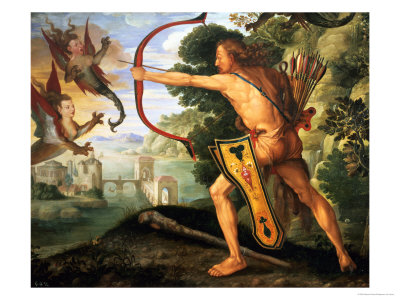 'Hercules and the Stymphalian Birds' by Albrecht Dürer |
