(continued from Herakles' Tenth Labour) Herakles' Eleventh Labour - The Apples of the Hesperides The ten Labours had taken Herakles eight years and one month, but as we’ve seen, Eurystheus refused to count the Second (Hydra) and the Fifth (Augean Stables), so poor old Herakles still wasn’t free! When Hera married Zeus, Mother Earth had given her a golden apple-tree, which so delighted her that she planted it in her own divine garden. This lay on the slopes of Herakles’ Eleventh Labour was to fetch Eurystheus fruit from this golden apple-tree, and as he didn’t have any idea of where the Garden of the Hesperides was, he set off to the river Po in Italy, where the oracular sea-god Nereus lived. Nereus was a shape-changer, also known as "The Old Man of the Sea", but Herakles knew well how to deal with shape-changers! When he arrived at the Po the river-nymphs showed him where old Nereus lay sleeping, and without hesitation Herakles grabbed Nereus around the waist and clung on while the sea-god went through many changes – an octopus, a leopard, a bear – practically a whole zoo full! Finally Nereus gave in, and agreed to prophesy how the golden apples could be won, in return for his freedom. Nereus advised Herakles not to pick the apples himself, but to persuade Atlas to do it for him while he relieved the Titan of his burden (remember that after the Titans warred unsuccessfully with the Olympian gods, Zeus condemned Atlas to support the Heavens on his shoulders for all eternity). To reach Atlas, Herakles had to cross After many other adventures Herakles arrived at the end of the world where he found Atlas with the weight of the Heavens on his shoulders. “Io Atlas, if you will pick the golden apples of the Hesperides for me, I will take on your burden for the while” said Herakles. Naturally Atlas was quite willing to give up his eternal task, but told Herakles that there was no way he could get past the dragon Ladon. For Herakles, however, this was not a problem, he grabbed the dragon at the base of his many necks and strangled him until he was dead. Returning to Atlas, Herakles bent his back to receive the weight of the celestial globe, and Atlas walked away, returning after a while with three apples plucked by his daughters. The new sense of freedom was heady wine for Atlas, and he thought to trick Herakles. “Just you hold up the sky a little longer” he said, “and I will take these apples to Erystheus myself”. Herakles had been warned by Nereus not to accept any such offer, so he begged Atlas to support the globe for just a moment while he put a pad upon his head. Atlas, as we have seen previously, was not the cleverest of Titans, so he laid the apples on the ground and resumed his burden. Herakles simply picked up the apples and went on his way with an ironic farewell! After some months Herakles brought the apples back to Erystheus, who handed them back to him; he then gave them to Athene, and she returned them to the Hesperidean nymphs since it was unlawful that Hera’s property should pass from their hands. Meanwhile Hera had set the image of Ladon among the stars as the constellation of the Serpent. Herakles had not gone straight back to Zeus had long ago repented of his punishment, because Prometheus had sent him a kind warning not to marry Thetis, lest he beget one greater than himself, so when his son Herakles pleaded with him to pardon Prometheus and set him free, he granted the request without demur. However, Zeus could not lose face among the gods by appearing to change his mind, so he stipulated that Prometheus should wear a ring made from his erstwhile chains, set with a Caucasian stone, in order to appear still a prisoner – and this was the first ring ever made to contain a setting. But it had been fated that Prometheus’ sufferings were destined to last until some immortal should voluntarily go to Hades in his stead; so Herakles reminded Zeus of the centaur Cheiron, who was in constant agony with his incurable wound, but could not find release in death because of the gift of immortality. This solved the final problem, so with an invocation to his brother Apollo the hunter, Herakles shot the griffon-vulture through the heart. Thus Prometheus was set free as an immortal, and Cheiron was finally able to die and find relief from his insufferable pain. Mankind now began to wear rings set with stones in honour of Prometheus, their champion, and also wreaths, because when Prometheus was set free he was ordered to crown himself with a willow wreath. Herakles kept him company by wearing one made of his favourite wild-olive. The arrow with which Herakles had shot Prometheus’ tormentor was set by Zeus among the stars as the constellation Sagitta (we call it Sagittarius), and ever after the inhabitants of the Caucasian mountains regarded the griffon-vulture as an enemy of mankind. They burnt out its nests with flaming darts and set snares for it, to avenge Prometheus’s sufferings.
|
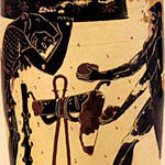
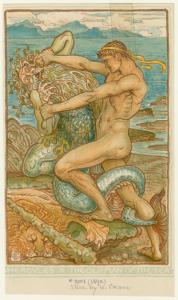 Herakles wrestles with Nereus 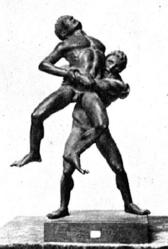 Herakles holds Antaeus aloft 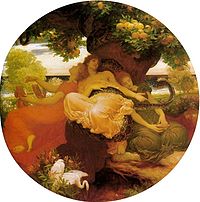 'The Garden of the Hesperides' by Frederick, Lord Leighton 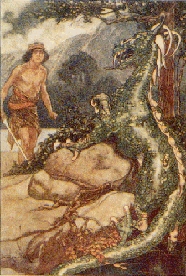 Ladon guards Hera's golden apple tree |
