(Continued from Herakles' Ninth Labour) Herakles' Tenth Labour - The Cattle of Geryon Geryon was supposed to have been the strongest man alive, and had three heads, six hands and three bodies joined together at the waist. He was the son of Chrysaor and Callirrhoë, who was a daughter of the Titan Oceanus. Geryon ruled Tartessus in Herakles' Tenth Labour was to fetch these cattle 'without either demand or payment' from the island Erytheia where they were kept. He travelled across Europe, and when he arrived in Tartessus set up a pair of pillars, one in Europe and one in Anyway, whichever he was doing, he was teased by Helius (the Sun), who beamed down on him so strongly that he found it difficult to work in the excessive heat. He finally lost patience, and fired an arrow at Helius, who shouted out 'Enough of that!' in anger and alarm. Herakles apologised for his ill temper, and immediately unstrung his bow to defuse the situation. Helius likewise apologised for his annoying behaviour, and courteously offered Herakles his golden water-lily-shaped goblet in which to sail across to Erytheia. Herakles used his lion-skin as a sail and set off in the goblet, but the Titan Oceanus was also in a playful mood, and made the waves pitch Herakles' makeshift vessel in an alarming way. Again Herakles drew his bow, which frightened Oceanus into calming the sea. When he arrived at Erytheia, he climbed At his arrival back in Tartessus, Herakles gratefully returned Helius' goblet and started what must count as the longest cattle-drive ever, through Spain to the Pyrenees, where he had a liaison with the Bebrycan princess Pyrene, who gives this mountain range its name, then into Gaul. Here he abolished the ancient and barbarous native custom of killing strangers, and so won the hearts of the Gauls that he was able to found a large city which he called Alesia, 'Wandering', in remembrance of his travels. Long afterwards the Gauls honoured Alesia as the mother-city of their land, and they claim descent from Herakles' union with the princess Galata, who chose him as a lover and bred that warlike people. Next Herakles passed over the When Herakles awoke, he noticed immediately that some of the cattle were missing, and searched around for them, but could find no sign. He was about to give up, and drive the remainder on, when he heard a distant sound - one of the stolen heifers was lowing hungrily. Herakles traced the sound to Cacus' cave, but the entrance was blocked by a huge boulder, which ten yoke of oxen could hardly have moved. Nevertheless, Herakles heaved it aside, and undaunted by the flames which Cacus belched from his three mouths, he battered the giant to a pulp with his naked fists. He built an altar to Zeus with Evander's help, and sacrificed one of the bulls in thanks for their recovery. According to the Romans, Herakles also freed King Evander from the tribute owed to the Etruscans and killed King Faunus whose custom was to sacrifice strangers at the altar of his father Hermes. He also abolished the annual sacrifice of two men to Cronus, whereby the two chosen men were thrown into the Herakles then planned to drive the cattle through Istria and 'When they grow up, watch carefully!' Herakles replied. 'And if any one of them ever bends this bow - thus, as I now bend it - and girds himself with this belt - thus, as I now gird myself - choose him as the ruler of your country,' So saying, he gave her one of the two bows he carried, and his golden belt, from which was suspended a golden goblet, and went on his way. The serpent-woman named her triplet sons Agathrysus, Gelonus and Scythes. The first two were unequal to the tasks specified by their father, but Scythes succeeded in both, becoming father of all subsequent Scythian kings, who thereafter wore a golden goblet on their belt. Having recovered his mares, and catching up with his strayed cattle, Herakles drove them back through |
 ERYTHEIA THE RED ISLE was a mythical island in the far western streams of the River Okeanos (the oceans were envisaged as a river that encircled the earth) which was bathed red by the light of the setting-sun. Erytheia was one of several mythical realms in the far west. Its neighbours included Hesperia the garden of the gods, Sarpedon island of the Gorgones, and Leuke the island-home of the blessed dead. Even further to the west, on the far shores of the river Okeanos, lay the gloomy realm of Hades. 
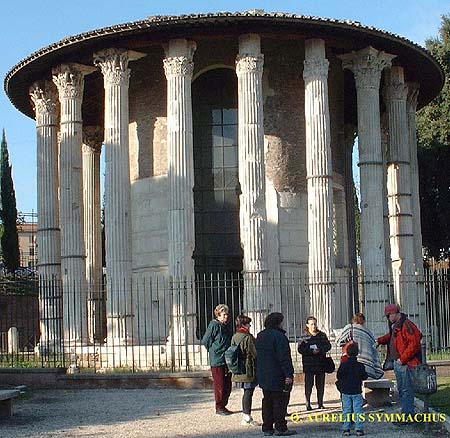 The Temple of Hercules in Rome |
