(Continued from Herakles' Third Labour) Herakles' Fourth Labour: The Erymanthian Boar For his fourth Labour, Herakles had to capture the Erymanthian Boar. The catch was, he had to take it alive! It was called the Erymanthian Boar because it lived on the slopes of Mount Erymanthus; it was a huge, fierce beast which ravaged the country around Psophis. Mount Erymanthus is interesting - it was named after a son of Apollo who was blinded by Aphrodite after he saw her bathing; Apollo took his revenge by changing into a boar (a different boar from the subject of Herakles's Labour) and killing Adonis, who was Aphrodite's lover. Those gods didn't mess about! It was deep winter. On his way to Erymanthus, Herakles stopped off to visit the Centaur Pholis in his cave. Centaurs had the body of a horse but with a human upper torso and head, and they were savage, primitive creatures; although Cheiron (their king) was renowned as a healer and teacher. Pholis gave Herakles roast meat, but he had his own meat raw, ripping it apart with his strong, sharp teeth. However, Pholis also had a jar of wine left there by Dionysos a hundred years before. Herakles reminded Pholis that Dionysos had intended the wine for this very occasion, so Pholis was obliged to open it. The reason that Pholis was so reluctant was that Centaurs reacted to wine very strangely - it sent them mad; they couldn't resist it. The other Centaurs smelt the strong wine and, very predictably, went insane. They rushed at Pholis' cave armed with great rocks, uprooted trees, axes - whatever they could grab! Herakles held them off with his arrows, but Nephele (grandmother of the Centaur race, who was a cloud) sent down a shower of rain to loosen his bowstring (if the bowstring got wet it lost its tautness, effectively making the bow useless) and make the ground slippery underfoot. Herakles still killed a number of Centaurs, until they ran off to Meleas and their king, Cheiron. Unfortunately one of Herakles' arrows got deflected, and hit Cheiron in the knee. Herakles was very upset, because Cheiron was an old friend, so he drew the arrow out and helped Cheiron dress the wound. The old Centaur was in agony (Herakles had dipped the arrows in the gall of the Hydra, remember), and retired to his cave; but he could not die because he was immortal. Prometheus later offered to accept immortality in his stead, and Zeus agreed to the arrangement, but some say that Cheiron chose to die not because of the pain which he suffered, but that he had grown weary of his long life. Zeus set up Cheiron's image in the stars; it is the constellation we still know as the Centaur. While Herakles was chasing the fleeing Centaurs, Pholus drew forth one of the arrows from one of his dead kinsmen and examined it. He wondered how such a relatively small wound could have killed a robust creature like a Centaur. Disaster! He dropped the arrow, and it hit him in the foot, the poison entered his blood and he dropped dead on the spot. When Herakles returned, already grief-stricken at the harm he had done to Cheiron, he found the dead body of his other Centaur friend sprawled outside his cave. He buried him at the foot of the mountain, which ever since has been called Pholoe in his honour. Herakles now turned his thoughts to the boar. He traced it to the river, also called Erymanthus, then, knowing that it was hiding in a thicket, started to shout as loud as he could. This startled the boar, who ran out of the thicket, straight into a deep drift of snow. This was exactly what Herakles had hoped for; while the boar was struggling to free himself, Herakles leaped upon its back, and wrapped it around with chains until it could no longer move. Back to Mycenae they went, Herakles striding along, the boar chained and helpless upon his back; but when he heard that the Argonauts were assembling for their voyage to Colchis, he dropped the boar off in the marketplace and went off to join the expedition. Poor old Eurystheus was left cowering in his big bronze jar!
|
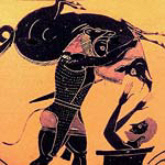
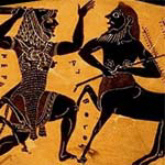 Herakles and the centaurs 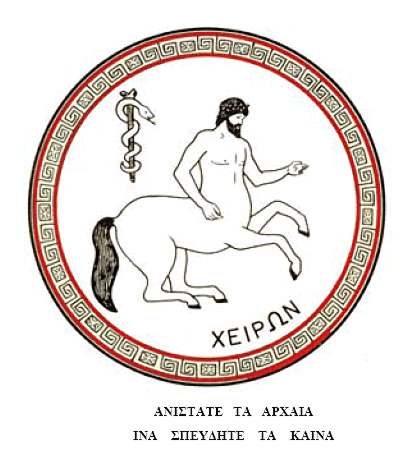 While the centaurs as a race were generally considered to be savage and undisciplined, Cheiron was the son of Cronos and the nymph Philyra. He was highly intelligent and civilised, and made his home on Mount Pelion. Cheiron was a healer and teacher, and was a tutor to many great heroes including Asclepius, Theseus, Achilles, Jason and Herakles. Eventually Cheiron became the sole surviving centaur (the others drank and dissipated themselves into extinction), and when he was given the opportunity to relinquish his immortality to Prometheus and die he took it willingly.  |
