Herakles' Third Labour: The Ceryneian Hind (Continued from Herakles' Second Labour) Eurystheus decided that Herakles was too difficult to kill by direct means. He had already overcome and killed two supposedly invulnerable monsters; something different was called for. He thought of the Ceryneian Hind - Herakles should capture this Hind, but because it was a sacred creature, he would have to capture it alive, spilling not one drop of blood. The hind was said to be so fast that it could outrun an arrow The Ceryneian Hind (also called Cerynitis) was a enormous creature, swift and with dappled skin, brazen hooves and beautiful horns of gold. When Artemis was a child she came upon five hinds, larger than bulls, grazing on the banks of a river, the sun flashing from their bright horns. She pursued them, and caught four, which she harnessed to her chariot; the fifth escaped and took refuge on the Ceryneian Hill - as Hera had intended, for she had Herakles's Labours in mind even in these early days! Herakles stalked the Hind tirelessly for a year, she fleeing before him, following her as far as Istria and the Land of the Hyperboreans (this means the Land beyond the North Wind, and is generally regarded as referring to Eurystheus had hoped to make Artemis angry with Herakles for descrating her sacred creature. As Herkles made his way back to Mycenae he was accosted by Artemis, who asked him why he had dared to lay hands on her sacred Hind? He told her that he had in no way harmed the beast, and that he was in any case compelled to perform whatever Eurystheus decreed for him. Artemis realised that Herakles was not to blame, thus foiling Eurystheus' plan, and let him take the Hind to Mycenae. When Eurystheus and Herakles met, Eurystheus declared that the Ceryneian Hind would become part of his menagerie. Knowing that he must return the Hind to Artemis, Herakles said that Eurystheus should come and take it from him, but the moment he released the creature it sprang away and back to its mistress. Eurystheus had not been fast enough, said Herakles, and that was that.
|
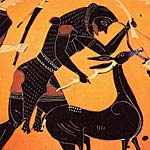 This story seems to go into the Celtic roots of Herakles. The Gauls (ancient Celtic inhabitants of what we now call France) identified this avatar of Herakles with Ogmius, who invented the Ogham alphabet (found on Celtic inscriptions all over Europe and the British Isles). The chase of the hind represented the pursuit of Wisdom, and she is found, according to Irish mystical tradition, harboured under a wild-apple tree. This is why Herakles was said not to have done any harm to the hind; instead he pursued her for a year to the Land of the Hyperboreans, who were the experts in these mysteries (the Druids of Britain were regarded as masters of mystical matters throughout Europe). This can be interpreted as a symbolic way of saying that Herakles spent a year in Britain studying with the Druids. The Ceryneian Hind was possibly a reindeer. This is the only type of deer where the female has horns, and can be harnessed to pull a chariot or sleigh. Remember that the Achaeans were originally nomadic horsemen from the north. They were probably familiar with the Baltic regions and reindeer, and preserved the memories in their legends when they moved south to Hellas It is interesting that the story tells that Hera had Herakles' Labours in mind well before he was even a twinkle in Zeus's eye! This seems to indicate a fatalistic approach to the passage of time, also puts the gods 'outside of time' in a way. 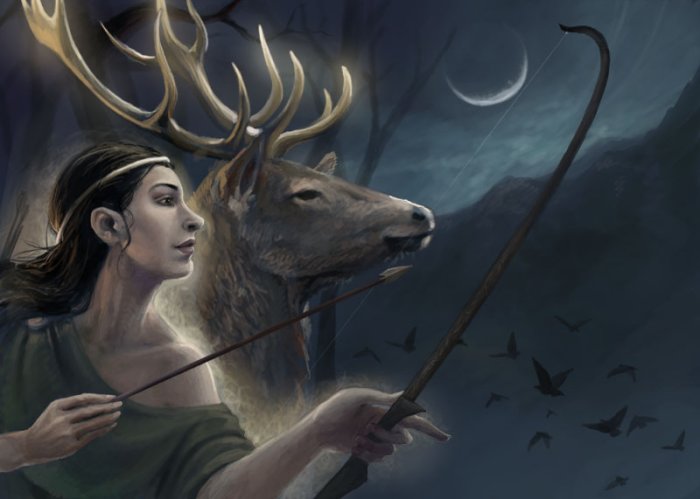 |
