(Continued from Herakles' Twelfth Labour) Herakles and Iphitus Free of his bondage to Eurystheus, Herakles realised that his had been a lonely life since he had lost his wife Now Eurytus had a fine bow, and had been taught its use by Apollo himself, so when Herakles beat him he was most put out. He used the excuse that Herakles had been responsible for the death of his first wife, Herakles took this as well as can be expected. Being Eurytus’s guest, he refrained from tearing him apart there and then, but swore that he would have his vengeance. Eurytus’s three younger sons supported their father in his dishonest decision, but the eldest, Iphitus, declared that Herakles had rightfully won the hand of his sister, and when, soon afterwards, twelve brood-mares and their foals disappeared from The real villain was, in fact, Autolycus. This fellow was a son of Hermes, and a famous thief, possessing the power (given to him by his father) to change the appearance of beasts that he had stolen. This is exactly what he had done to Eurytus’s mares and foals, and to add that final bit of irony to the story, he had sold them to Herakles as his own! Anyway, Iphitus followed the tracks of the stolen horses, and found that they led towards After feasting Iphitus, they climbed the highest tower in Herakles tried to have himself purified of this murder, but none that he approached would have anything to do with him, until finally Nestor, son of Neleus king of Pylus, persuaded Deiphobus to purify him at Amyclae. Nevertheless, he still suffered from nightmares, so went to the Delphic Oracle to ask how he might be rid of them. The Pythoness Xenoclea refused to answer his question. ‘You murdered your guest’, she said. ‘I have no oracles for the like of you!’ ‘Then I shall set up my own oracle!’ cried Herakles, and so saying he pulled the tripod on which Xenoclea sat right from under her! Now the oracle at ‘Who will have me as a slave?’ asked Herakles, humble now that his foul temper had abated and he was in his right mind. ‘Queen Omphale of |
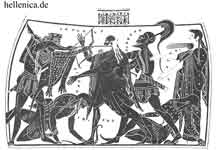 EURYTUS was said to be the grandson of Apollo, who gave him his bow. According to Homer, Eurytus became so proud of his archery skills that he challenged Apollo. The god killed Eurytus for his presumption, and Eurytus' bow was passed to Iphitus, who later gave the bow to his friend Odysseus. It was this bow that Odysseus used to killed the Suitors who had wanted to take his wife, Penelope.
AUTOLYCUS was the son of Hermes and Chione. Chione was exceedingly beautiful and had many suitors, including the gods Apollo and Hermes. One night Hermes put her to sleep and he and Apollo raped her. she gave birth to twin boys; Autolycus was the son of Hermes and Philammon the son of Apollo. Chione became so obsessed with her own beauty that she challenged the goddess Artemis, who shot and killed her with an arrow. Autolycus was the grandfather of Odyseus and Jason, and was himself one of the Argonauts who accompanied Jason to steal the Golden Fleece. He also stole the helmet of Odyseus, his own grandson, and the herds of Sisyphus (who killed guests, seduced his own niece and stole his brother's throne, before being condemned to Tartarus by the gods for his misdeeds). Herakles was taught wrestling by Autolycus as a youth.
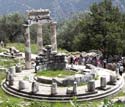 The Oracle at Delphi 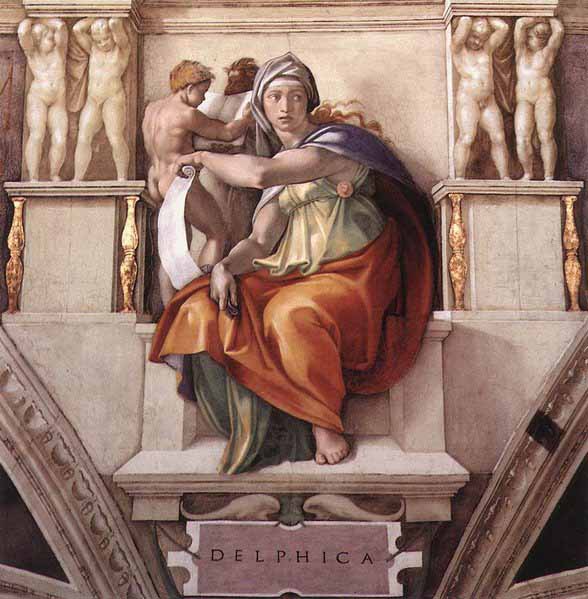 The Pythoness |
