(Continued from Herakles and Iphitus) Herakles and Queen Omphale Herakles was taken to Asia and offered for sale as a nameless slave by Hermes, who was the god of all financial transactions. Afterwards, Hermes offered the purchase money of three silver talents to Iphitus’s orphan children. Eurytus, Iphitus’s father, however, was in an unforgiving mood, and forbade his grandchildren to accept the money, ‘Only blood will pay for the death of my beloved son!’ he raged. As predicted by Xenoclea, Herakles was bought by Omphale, Queen of Lydia, who knew a good bargain when she saw one, and he served her faithfully for a year. Omphale had been left the kingdom of Lydia by her husband Tmolus, son of Ares and Theogone. Omphale was known to Herakles. When he had obtained the girdle of Hippolyte the Amazon for Eurystheus' daughter as his ninth Labour, Herakles had given Hippolyte’s axe to Omphale, so they must have been good friends. Now, according to some versions of the story, Omphale did not recognise Herakles until the very end of his servitude, but unless she had been put under some sort of spell by the gods, I can’t believe that she did not know very well who her newly-acquired slave was. The fact was that Omphale had not purchased Herakles to perform menial tasks, but to be her lover. She had three sons by him (so they were together for rather longer than a year) called Lamus, Agelaus and Laomedon. But while Herakles was with Omphale he did do a lot to rid Asia Minor of the bandits who infested it during his stay. Among the many works which Herakles performed during his servitude was the capture of the two Ephesian Cercopes, twin sons of Oceanus by Theia, and the most accomplished cheats and liars known to mankind. Theia despaired of the two rapscallions and warned them to avoid the trouble which she saw coming. Her words ‘My little White-bottoms, you have yet to meet the great Black-bottom’ have become proverbial, ‘white-bottom’ meaning a base, lascivious scoundrel. The twins chose to disregard her, however, and in the form of two bluebottles would buzz around Herakles’ head while he was trying to sleep, and keep him awake. One night he grabbed them, forced them to resume their proper shape, and carried them off, dangling upside down from a pole which he carried over his shoulder. In this position they had an excellent view of Herakles’ behind, which was not covered by his lion-skin. Now Herakles’ bottom had been tanned by continual exposure to the wind and sun, and burned by the fiery breaths of Cacus and the Cretan Bull. In short, the two scapegraces realised that this was the ‘black-bottom’ of which their mother had warned, and burst out in laughter at the realisation. This, as you might expect, came as a great surprise to Herakles, and he asked them what was causing them so much mirth. When they told him, he sat down on a rock and laughed so hard himself that they persuaded him to release them. The story goes that they eventually annoyed Zeus so much that he turned them into monkeys. Another time Herakles heard of a Lydian named Syleus who would seize passing strangers and force them to work his vineyard. Herakles tore up the vines by their roots, putting an end to that little game. When Itonians began plundering Omphale’s country, Herakles recovered the booty they had taken and razed their city. And at Celaenae lived a bastard son of King Minos called Lityerses. He would offer hospitality to travellers, but force them to compete with him in reaping his harvest. If they got weary and slowed, he would whip them, and at the end of the day, if he had won the contest, he would behead them and conceal their bodies in the sheaves. Herakles visited Celaenae to rescue the shepherd Daphnis, a son of Hermes. Daphnis’s girlfriend, Pimplea, had been captured by pirates, and Daphnis had scoured the world to find her. He had eventually discovered that she was among the slave-girls of Lityerses, and on confronting Lityerses was challenged to the reaping contest. Herakles took his place, and out-reaped Lityerses, whom he decapitated with his sickle and threw into the river Maeander. Daphnis married Pimplea and Herakles gave them Lityerses’ palace as a wedding gift. Finally, beside the river Sagaris, Herakles used his prowess with the Scythian bow to shoot dead a gigantic serpent that had been terrorising the locale, destroying men and crops. In gratitude Omphale gave him his freedom and sent him back to Tiryns with many fine gifts. When Herakles arrived back in Greece he found that swift-flying rumour had reached there before him. The story that was doing the rounds of the Hellenic city-states was that Herakles had abandoned his lion-skin and aspen wreath to wear instead jewelled necklaces, women’s gowns of fine silk, and a woman’s turban and shawl. It was said that he spent his days surrounded by wanton girls, spinning and weaving, and trembling lest Omphale scolded him! What had really happened was quite simple. While he and Omphale had been visiting her vineyards, she wearing a beautiful purple gown embroidered with gold, he holding a golden parasol over her head, they had been espied by the god Pan. Pan had instantly fallen in love with Omphale, and said goodbye to his mountain-nymphs, crying: ‘Henceforth she alone will be my love!’ Omphale and Herakles reached their destination for the night, a secluded grotto, where they had, in fun, exchanged clothes. They laughed at the sight that they made, she tottering under the weight of his lion-skin, he stumbling in golden sandals far too small for his feet, almost splitting the seams of the purple gown. They had vowed a dawn sacrifice to Dionysus, so slept separately as was required under such circumstances. At midnight, Pan crept into their grotto, and felt around in the darkness until he felt the fine weave of Omphale’s dress. With quick hands Pan untucked the bed-clothes and wriggled in beside the sleeper, but what he embraced was not the soft skin of the Queen, but the weathered flesh of Herakles, who woke, startled, and kicked Pan clear across the grotto! Omphale heard the crash and the howling and called for lights, and when she and Herakles saw Pan huddled in a corner nursing his bruises they laughed until they cried! Since that day Pan has abhorred clothing, and his priests and officials conduct his rites naked, but he got his revenge on Herakles by spreading the gossip that Herakles habitually dressed as a woman for perverse reasons. Unfortunately, such gossip is readily believed, and vase-paintings can be seen of Herakles dressed in petticoats, letting himself be combed and manicured by Omphale’s maids, while she is depicted dressed in his lion-skin and wielding his club. NEXT: Herakles and Deianeira |
 The Death of Tmolus Tmolus fell in love with Arhippe, an attendant of Artemis, while on a hunting trip. Now, as an attendant of Artemis, Arhippe was vowed to remain chaste, so when Tmolus entreated her to become his lover, and threatened when his entreaties failed to have effect, Arhippe fled to her mistresses temple. Unfortunately Tmolus was one of those people who think their desire overrides all other considerations – probably being a king didn’t help Tmolus to accept rejection. He followed Arhippe into Artemis’s temple and ravished her there and then. Arhippe afterwards hanged herself from the rafters of the temple, calling upon Artemis to avenge her. That sort of appeal to the gods rarely goes unanswered. Artemis loosed a mad bull upon Tmolus; he was tossed into the air and fell upon a sharpened stake. Impaled and helpless, he died in torment. 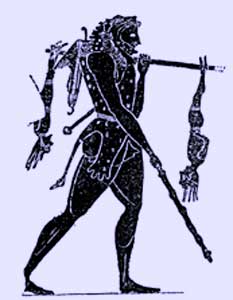 Herakles and the Cercopes The story of Herakles and Ltyerses may well be yet another tale of Herakles abolishing an instance of human sacrifice. 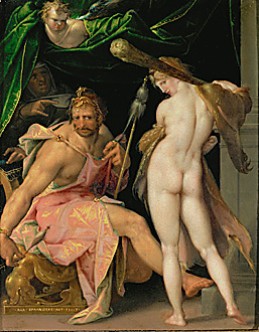 Herakles and Omphale, by Bartholomaeus Spranger (c. 1600). Notice that Herakles is depicted wearing Omphale's clothing and jewelry while Omphale has Herakles' lion skin and club |
